

ResourcesEverything in One Place
Your LinkedIn Page is now an AI Visibility Asset
At Builder Designs, we've spent years helping home builders strengthen their digital presence through websites, SEO, and marketing strategies designed to increase visibility and generate qualified leads. Today, that visibility extends far beyond traditional search engines. As AI-powered platforms become a primary way buyers discover and evaluate businesses, one digital asset is quietly becoming more important than many companies realize: your LinkedIn business profile.
The way buyers find and vet businesses has fundamentally changed. AI-powered tools like ChatGPT, Perplexity, and Google's AI Overviews are increasingly the first stop in the discovery process, assembling answers from sources they deem credible and structured. And one of the sources those systems trust most? Your LinkedIn business profile.
While most companies have treated LinkedIn as a secondary channel, something to update occasionally and revisit during a rebrand, it has quietly evolved into a primary data source for AI-driven search experiences. That means your LinkedIn page is no longer just a professional presence. It is an active input into how AI systems describe, categorize, and recommend your business to potential clients. Optimize it well, and you build authority that compounds. Leave it stale and you risk being misrepresented, or missed entirely, right at the moment someone is asking exactly the right question about what you do.
The Shift Nobody Saw Coming
For years, the advice around LinkedIn has been consistent: keep it updated, post occasionally, collect connections. It was treated largely as a digital résumé or a B2B networking venue, useful, but not exactly urgent.
Then AI-powered search arrived, and everything changed.
Tools like ChatGPT, Perplexity, Google's AI Overviews, and Microsoft Copilot don't just crawl websites the way traditional search engines do. They synthesize answers from sources they've been trained on or can access in real time, and LinkedIn is near the top of that trusted source list. When someone asks an AI assistant, "Who are the top digital marketing agencies in [city]?" or "What does [your company name] specialize in?" the AI is often pulling directly from LinkedIn business profiles to construct that answer.
That makes your LinkedIn page less of a social profile and more of a structured data feed that AI systems are actively reading.
Why LinkedIn Gets Trusted by AI Systems
Not all online content is created equal in the eyes of an AI. These systems are designed to prioritize sources that are authoritative, consistent, and structured. LinkedIn checks every one of those boxes.
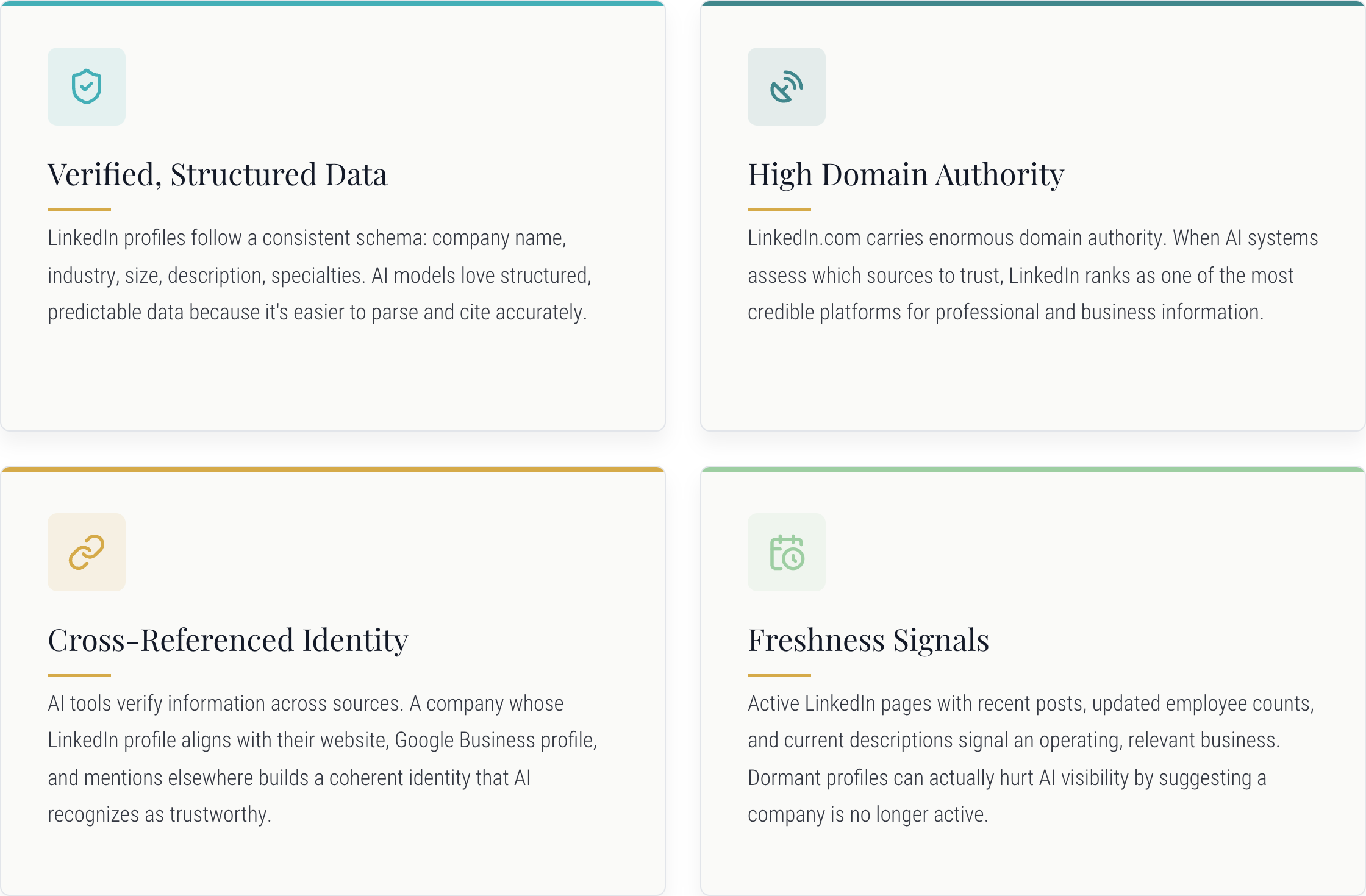 What AI Pulls From Your LinkedIn Profile
Understanding exactly what AI systems are reading and reproducing from your LinkedIn page is the first step to optimizing it strategically. It's not just your "About" section. Here's what's actually being surfaced:
Company description and tagline. This is the single highest-impact field. AI systems regularly pull the opening lines of your company description verbatim when answering questions about what your business does. If your description is vague, keyword-stuffed, or outdated, that's exactly the impression an AI will broadcast to whoever's asking.
Specialties and industry category. The "Specialties" field on LinkedIn functions almost like tags in a structured database. AI systems use these to categorize and match your business to relevant queries. If you haven't populated this field thoughtfully, you're leaving placement on the table.
Employee count and growth signals. Company size indicators influence how AI presents your business in comparisons. Keeping this range current matters more than most people realize.
Founder and leadership profiles. Your team's LinkedIn profiles are often cited when AI answers questions about company leadership, expertise, or credentials. The authority of your company page is directly amplified by the richness of your leadership team's individual profiles.
Recent posts and content. AI tools with real-time access treat your recent LinkedIn content as evidence of what your company is currently focused on, thinking about, and offering. A company that posts thoughtful content about its area of expertise is one an AI is more likely to recommend.
The Brand Authority Connection
AI visibility and brand authority aren't separate goals. They reinforce each other in a direct loop. Here's how it works in practice:
When your LinkedIn profile is clear, credible, and consistent, AI systems cite it confidently. Those AI-generated answers reach people who are actively asking questions about your industry or category, often people who haven't heard of you yet. When those people encounter your business name in a trusted AI response, it creates a first impression of legitimacy before they've ever visited your website.
That is brand authority operating at scale, passively, without an ad budget.
The reverse is also true. Inconsistent information, a LinkedIn description that doesn't match your website copy, a stale company size, a founder profile that lists a different title than your About page, creates what AI systems read as conflicting signals. Conflicting signals lower confidence, and lower confidence means you get cited less, or not at all.
Consistency across your digital presence is no longer just good housekeeping. It's an AI ranking factor.
This Isn't Just a LinkedIn Strategy
It's worth stepping back and naming what this actually is: a structural shift in how discovery works for businesses.
For the past decade, the game was SEO: ranking pages on Google so people could find you when they searched. That game still exists, but it's now layered with a newer one: ensuring that when AI systems assemble answers about your category, niche, or location, your business is represented accurately and favorably.
LinkedIn is one of the clearest, highest-leverage places to play that game right now because it's already trusted, already indexed, and already being pulled from. You don't have to build anything new. You just have to make what's already there as strong as possible.
The businesses that understand this early will build AI visibility advantages that are genuinely difficult for competitors to catch up to. The ones that ignore it will find themselves absent from answers their ideal clients are already receiving.
Your LinkedIn page is speaking on your behalf to AI systems, right now, whether you've optimized it or not. The only question is whether you like what it's saying.
Making Sure Your LinkedIn Page Is Working for You
The good news is that improving your LinkedIn presence doesn't require starting from scratch. Most businesses already have the basics in place. What matters is making sure those basics are accurate, specific, and consistent.
Start with your company description. Read it as if you've never heard of your business before and ask whether it clearly communicates what you do, who you serve, and what makes you different. If it's vague, generic, or hasn't been touched in a few years, it's worth a rewrite.
From there, check your specialties, industry category, and company size to make sure they're current and reflect how your business actually operates today. Look at your leadership team's profiles and confirm that titles and company names are consistent with what appears on your business page. And if your last company post was months ago, a few thoughtful updates about
These details together help shape the story AI systems tell about your business, and the businesses that take time to get these details right are the ones AI systems represent most accurately and most often.
Want to know how your business appears in AI-generated search results? Contact Builder Designs for an AI visibility assessment and discover opportunities to improve your brand authority across your website, LinkedIn presence, and other key digital assets that influence AI recommendations.

 Call
Call